TDRA Works on Burnell Open Space
Above image - 2025 TDRA proposals overlayed with 2026 proposals:
Note The ‘key’ for the image above is as
- Areas of “greyish” vegetation = “indicative canopy to be retained over 3 metres high”
- Many individual round greenish circles in the “main work area” = new “individual tree planting”.
- Neon Green = extent of underground infrastructure.
- Paler green with small black outline = “supported grass areas”
- Blue Border = the Flood Compensation areas -very ill described in the consultation.
- Black dots/ squares = Hatches and the shaft access.
- Grey areas = the intake and outfall.
Intake Works Area
The new river water intake structure will be built on the riverside towpath on Burnell Riverside Open Space upstream of Teddington Weir. The intake structure will be approximately 30m wide and several metres in height above normal water level and 2.4m above the level of the top towpath. The structure could be set into the riverbank by about 9.5m and extend into the river by up to 3m.
Thames Water indicates a construction timeline for the Burnell site of 4 years.
A shaft and tunnel will be constructed to take the abstracted water to the existing Thames Lee Tunnel (TLT). A large excavation will be needed for the pumps (at least 3) that will move the water to the TLT.
20 access hatches will be placed around the open space area near the intake
Thames Water now describes a 10m x 7m control building with a 1.5m path on 3 sides on Burnell Open space to house mechanical and electrical items.
The construction compound at Burnell Open Space will take up more than half of the open space resulting in disruption to the thousands of people that use the towpath and open space regularly.
There will be a period of several months when there will be works in Park Gate woods for utility changes as part of the project. This means working near protected trees and badger setts.
In a drought millions of litres of water would be taken from the river. In periods of drought, the river will be at its most stressed, and the possibility of ecological harm is ever present.
![REALITY]](http://saveourlandsandriver.org.uk/wp-content/uploads/2026/02/REALITY.png "REALITY]")
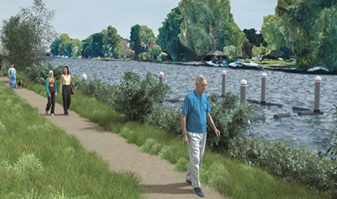
At the statutory consultation Thames Water presented “indicative designs” of what the new abstraction and riverside area would look like at Burnell Riverside Open Space. There were no details of the height of fences, no details of the size or design of the large kiosk, no details of materials to be used – but despite the absence of details there were assurances that the end result would be a positive addition to the Thames Riverside.
With that in mind look at the images above; first, Thames Waters impression of the TDRA abstraction; second, a Severn Trent impression of a new abstraction they recently built. (Note how similar the indicative designs are!).
Then look at the final two images. Those show the reality of the Severn Trent construction. It is not the lovely result that was promised. Note the many elements – fences, shaft covers, very large kiosk, unrecovered vegetation, that were not obvious in the “impression”. Can we really believe that Thames Waters TDRA abstraction will be any better? Thames Water’s TDRA design visuals are like a fairy tale, except one where beautiful swan is turned into an ugly duckling.
The TDRA Kiosk.
In the 2025 statutory consultation Thames Water described a “kiosk” (to house intake and outfall’s control and other equipment) that would be approximately 5.5m by 5m.
In the 2026 the Kiosk has become a Control Building, increasing in size to around 7m by 10m, with a flat roof. In addition, there would be a path roughly 1.2m wide around three sides of the building.
In 2025 the building was to be screened by trees as much as possible. Given the much larger size of the new building and that many of the trees will be razed in the construction phase, this seems an optimistic notion. It is not known yet if there will be a separate building for the bio-bullet dispenser. A bio-bullet dispenser is used to control invasive mussels, (to stop them fouling the pipes). It was mentioned in 2025 but there is no update on it. There is no mention of security measures for the control building nor how often it would be visited for maintenance.
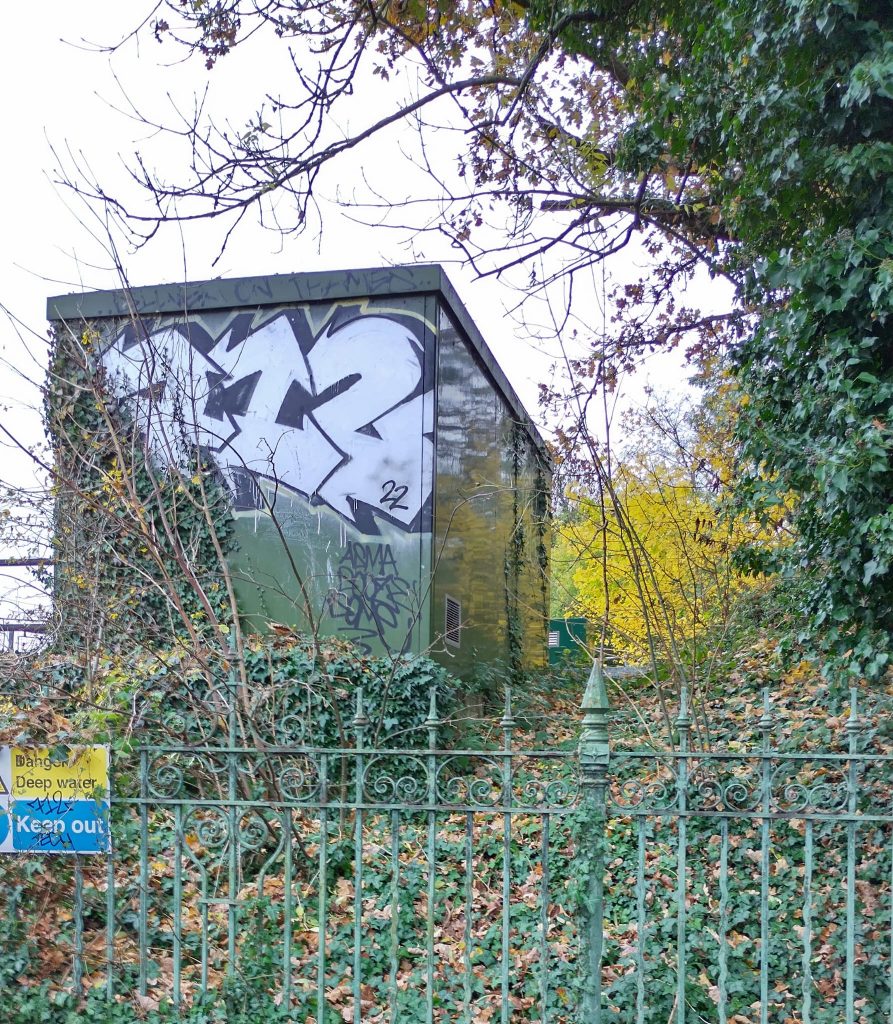
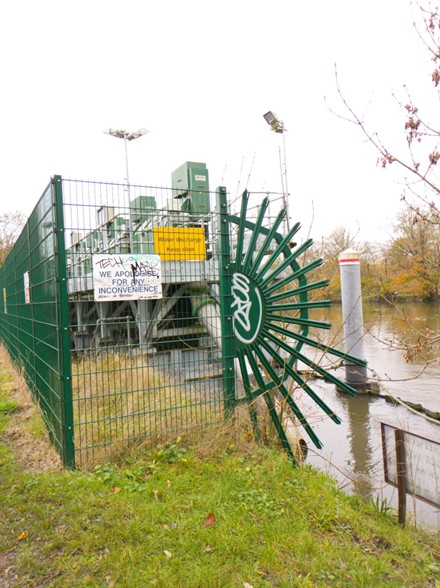
The imagery for the control building is vague to the point of obscurity. The photo above (left) is a kiosk beside the Bessborough river Intake. What that photo highlights is the possibility of anti-social graffiti appearing on a building in the public arena. It also shows the kind of typical security fencing associated with intake and kiosk infrastructure (see also picture above right).
The Treated Sewage Outfall.
In a drought 75 million litres a day of treated sewage would be pushed into the river at this location (next to Burnell Open space). The river will be at its most stressed, and the possibility of ecological harm is ever present.
Please CLICK HERE to find out more about the environmental issues of treated sewage.
There were two possible outfall designs in 2025 - Thames Water selected the In-River outfall in 2026.
To the left; the "in-river" outfall -Treated sewage will go into the river through underwater pipes and diffusers. These would be located within and on the riverbed, roughly six to eight metres from the riverbank. Permanent in-river structures (posts with ropes and buoys) would be needed to protect the outfall structures and river users. These would take up approx. 15x15 metres of the river area. At no point has Thames Water given clear descriptions of the impact of this outfall on river users, paddleboarders, boaters, swimmers.
There are 14, 2m by 2m shafts associated with the outfall and the tunnel shaft of 3m by 4m. There is a “flood compensation area” associated with the outfall – no realistic description provided of what that will look like , if trees can be planted on it and what land profile changes it will have.
Groundworks-removal of Vegetation
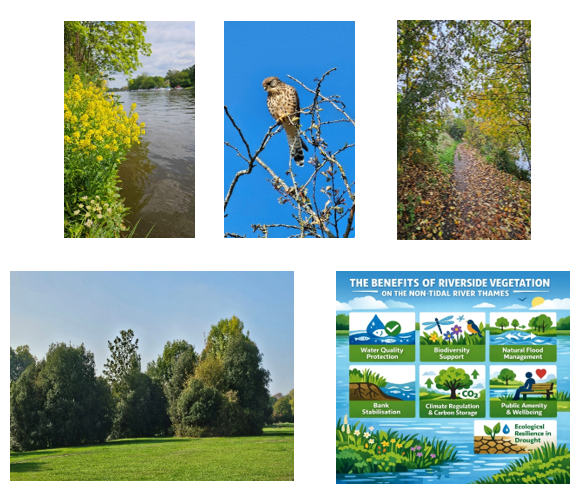
Below are some photos from Burnell Riverside open space. Trees, shrubs and grass provide a range of environmental benefits to the riverside and riversedge. They provide shade, which helps lower the temperature of the river near the edge and of the land beneath the trees and shrubs. This benefits animals, insects and people! Differing levels of the riverside grassland means there are a variety of habitats for butterflies and other insects. Trees and shrubs provide a habitat for a variety of animals, bats, birds and insects.
The ground works for TDRA at Burnell Riverside open space will raze a swathe of trees and shrubs to the ground as well as removing the top soil layer of the open space. Where Thames Water indicate some areas of "canopy to be retained" this applies to plants over 3 meters high. So, anything smaller is fair game for the excavators. The different levels of grassy areas will be flattened and there is no clarity as to how any mitigation planting will make up for what is lost.
The excessively wide towpath at the intake is there to disguise up to 10 access hatches. It will also limit the areas available for biodiversity / re-planting.
There is now a plan for a large area of "concealed supported grass" for maintenance access. This cannot have tree planting on it.
The 2026 brochure’s indicative imagery shows the proposed new individual tree planting as if the trees were around 15 years old. In reality, new trees take years to establish and can have a high failure rate. As climate change makes drier conditions more likely, any new planting would need exceptional management to survive. The supported grass areas would also require careful maintenance.
The amount of tree/shrub and then topsoil removal, not to mention land profile changes will degrade Burnell Riverside Open space. It will become more exposed to the elements, less shaded from sun, be less people and wildlife friendly and have less biodiversity in the soil biome and at the river’s edge.
Attached is an image showing the potential areas of trees and shrubs that could be razed to the ground. This would mean a significant amount of the riverside vegetation shown in these photos would be gone.
The destruction of green spaces, especially those by rivers, should only happen when the the benefits outweigh the negatives. Thames Water say there is no alternative. We say there are.