
TDRA, Mogden STW and surrounding areas.
In May 2026 Thames Water announced significant changes in the design of the TDRA project.
In September 2026, Thames Water put out some information on the changes in TDRA design that will impact Mogden and surrounding areas.
They are running what they call a “targeted consultation” on these changes. If you have been “targeted” please make sure you respond!
Shame on Thames Water for once again claiming transparency and engagement whilst limiting scrutiny of their TDRA decision making.
Thames Waters description of the changes at Mogden make it clear that the upheaval in the area will be worse than it forecast in 2025:
- The construction phase of the project has been extended from four to six years, starting in 2028 ending at the end of 2034.
- Lorry movements will total 83,500, not 47,886 as it said before.
- At their peak they are expected to be 200 a day - in autumn 2029 - double the previous forecast. Outside of 2029 there will still be significant numbers of extra HGVs on the roads.
- There will be more traffic congestion at the A316 Chertsey Road/B361 Whitton Road, B361 Whitton Road/Rugby Road and the Mogden Lane Roundabout junctions during peak hours.
- Mogden’s southern surrounding embankment is to be reduced and priority habitat of deciduous trees felled to accommodate the new treatment plant, bringing it closer to Beaumont Place and Mogden Lane and the houses there.
- The main TBM tunnel entry in the south-west of the site will move construction close to houses in Harvesters Close and Glen Walk, with associated noise, dust and night-time working.
- When the “testing phase” of the plant is added to construction timeline, water from the scheme will not be available until 2035.
- Engineering magazines have suggested a possible £500 million cost for the construction of TDRA and then there will be £500 million to operate. These are the least cost scenarios. The cost implications of the changes at Mogden and at Burnell Riverside have not been published. We believe it will represent really bad value for customers.
Please get your MP and local councillors to really push Thames Water on these changes.
Remember, constructing TDRA means it may not be possible to use Mogden an Indirect Potable Reuse source – thus limiting a possible new water resource for London. How does this make sense?
Space: Mogden is constantly described as “space constrained”. Thames Water has a capital investment forecast which describes works of varying types in Mogden from 2027 for 54 months. This would be ongoing at the same time as the start of construction of TDRA! Concurrent works at Mogden means even more impact on traffic volumes, air quality etc and also increasing risk around the working of the site.
In 2025 RAPID highlighted that there is no “… detailed plan for [an] alternative option if the space at Mogden Wastewater Treatment Works is no longer available to use. The space is limited and in high demand and finding an alternative space may lead to changes in the TTP layout, design, and location within Mogden. This could lead to an impact on the scheme costs and programme.”
So the potential to change the location of the TTP has been on the cards for a long time! It is incredible that Thames Water has still not described how construction of the TDRA infrastructure will not interfere with the operation of Mogden STW nor with the need to increase the capacity of Mogden over time.
Scroll Down to discover more.
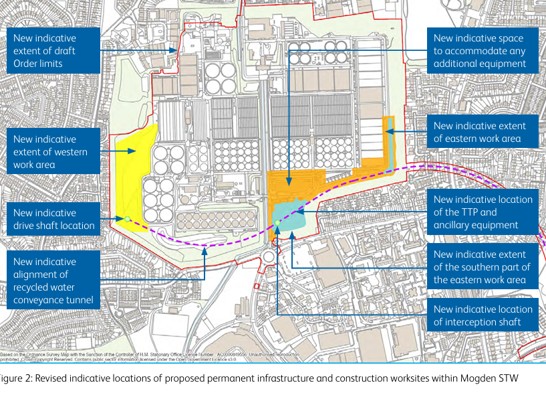
Below are more details on the changes made to the TDRA scheme and how Mogden and surrounding area will be affected.
Mogden is a very constrained work site. Construction work at this level and for this length of time could risk interfering with its core purpose of treating sewage; Relocating the deluge tanks, new electrical infrastructure, power connections and pipes, holding areas for HGV. Is the risk worth it and who should be consulted about it?
Thames Water mention that further changes to the layout of the TTP may be needed but give no idea on what that means for costs, operation or construction design. The only detail is that the space needed would include the space currently occupied by the powerhouse building.
TDRA is being pushed as a national infrastructure. Therefore, the changes as proposed around the Mogden site should have been presented in an open consultation to everyone that is interested in TDRA.
The following are some of the possible adverse impacts of the Mogden changes;
TRAFFIC- Thames Water says "Despite [mitigation] measures, it is likely that an increase in HGV movements would result in an adverse effect on traffic congestion at A316 Chertsey Road/B361 Whitton Road, B361 Whitton Road/Rugby Road, and the Mogden Lane Roundabout junctions during peak hours". Comment - there will clearly be negative impacts on a wide range of people.
AIR QUALITY - Thames Water says that the proposed location of the drive shaft in the southern part of the western work area would move the construction works closer to residential properties, including Harvesters Close and Glen Walk, to the west and south of the site. The proposed relocation of the TTP and interception shaft would move the works, with the nearest properties now located at Beaumont Place and Mogden Lane. DUST Thames Water says "Given their proximity, there is potential for dust effects during construction. However, the implementation of good practice mitigation measures set out in the outline CoCP is expected to effectively control dust emissions and manage any likely significant effects". Comment – 5 years of construction dust including during expected very dry summers should mean more detailed mitigation. The use of the word “expected” is not a commitment it is a generic phrase about generic building controls and does not commit any builder to anything extra. Air quality from the huge increase in traffic is dismissed as of no impact “given the existing air quality in the area and the relatively low number of vehicles expected during construction”. It is hard to understand this statement in the context of the increased traffic volumes.
NOISE - Thames Water says "At the western work area, the changes would mean the drive shaft is closer to some residential properties [Harvesters Close, Glen Walk]. Without mitigation, there are likely to be significant effects during the night-time tunnelling works. Mitigation in the form of a noise barrier to south and west of the western work area would remove the likely significant adverse effect. At the southern part of the eastern work area, the new works would be close to residential properties, and others to the east in Beaumont Place. However, with no night works planned at this location, it is unlikely there would be any significant effects from noise or vibration during construction". Comment – no night works does not mean no noise at the Southern worksite. Thames Water uses the word unlikely to avoid specifying more details of impacts on residents and there is no mention of mitigations. The described mitigation of a noise barrier on the southern worksite is not stated as a commitment – that must be clarified at the DCO.
TOWNSCAPE AND VISUAL - Thames Water says "Due to these additional likely significant townscape and visual effects, we’ve expanded the visual impact assessment work that we’re undertaking for our development consent order application to include new and amended viewpoints, including from Mogden Lane, Beaumont Place, the southern end of Harvesters Close and closer to the southern end of the eastern work area". Comment – there will definitely be more impacts on the landscape in the area – and Thames Water are avoiding describing these fully until they make their DCO application.
TERRESTRIAL ECOLOGY - Thames Water says "Removal of priority deciduous woodland. The amount of woodland being removed would increase compared with what was previously proposed. As Mogden STW is an operational site, it may be difficult to replace woodland within the site itself. Opportunities to both replace woodland and enhance areas of retained woodland, to compensate for loss, are being explored. On a precautionary basis, it has been identified that this woodland loss may lead to a potential likely significant effect on terrestrial ecology". Comment – This impact may well have implications for the BNG of the TDRA project. Thames Water have never fully committed to local enhancement or mitigation for habitat loss and this continues this trend.